Более 19 лет опыта - Поставщик комплексных решений по смешиванию и упаковке порошковых и гранулированных материалов.


Смесительное оборудование


Understanding the Working Principles of Industrial Mixing Equipment
Different industrial mixing machines create different material movement patterns. Understanding how ribbons, plough blades, paddles and rotating vessels work helps you identify the right mixing technology for your powder processing requirements.
Why Does the Mixing Mechanism Matter?
The mixing mechanism determines how materials move inside the mixing chamber. It influences the interaction between particles, the distribution of ingredients, the mixing intensity and the suitability of the equipment for different material characteristics.
For example, a ribbon agitator creates axial and radial material circulation, while a ploughshare agitator generates more complex movement through plough-shaped blades. Rotating vessel mixers use repeated material splitting, tumbling and recombination to blend dry powders and granules.
1. Horizontal Ribbon Mixer: Counter-Current Mixing Action
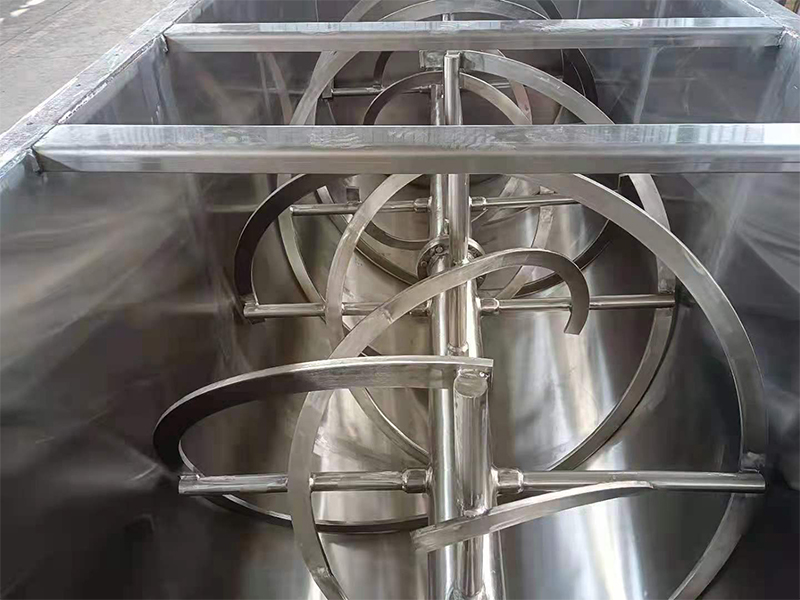
A horizontal ribbon mixer uses inner and outer helical ribbons installed on a central shaft. During operation, the outer ribbon moves materials from both ends toward the center, while the inner ribbon transports materials in the opposite direction.
This counter-current movement creates continuous axial circulation. At the same time, the rotating ribbons redistribute material across the cross-section of the mixing trough, helping different ingredients come into repeated contact.
We offer horizontal ribbon mixing solutions for powder, granule and selected powder-liquid processing applications. Optional configurations can be considered according to material properties, mixing requirements and production conditions.
2. Ploughshare Mixer: Intensive Material Circulation
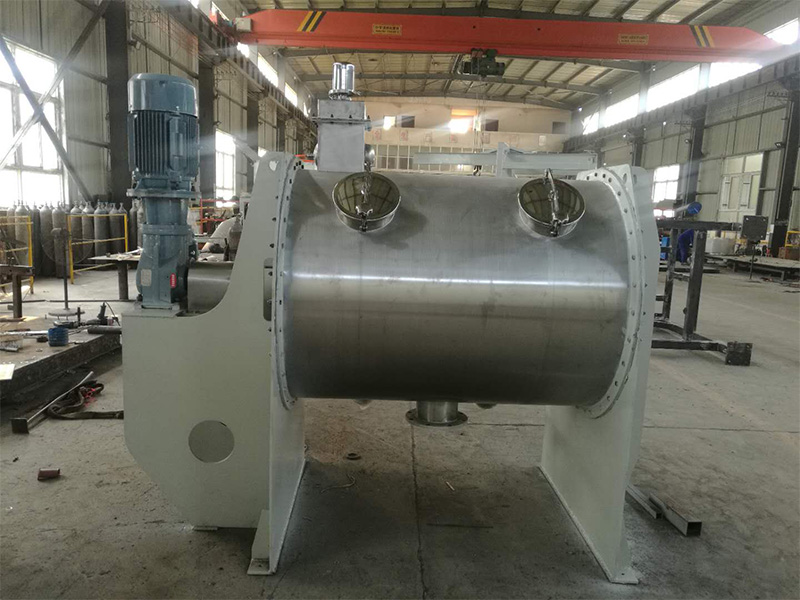
A ploughshare mixer uses specially shaped plough blades mounted on a rotating shaft. The blades lift, redirect and disperse material throughout the mixing chamber, creating complex three-dimensional material movement.
Compared with conventional ribbon circulation, ploughshare mixing provides a different mixing intensity and can be useful when processing cohesive powders, agglomerated materials and certain powder-liquid combinations.
For applications involving liquid addition, high-speed choppers and liquid spray systems can be considered as optional configurations where the process requires additional dispersion or agglomerate breakdown.
3. Double Shaft Paddle Mixer: Combined Convection and Dispersion
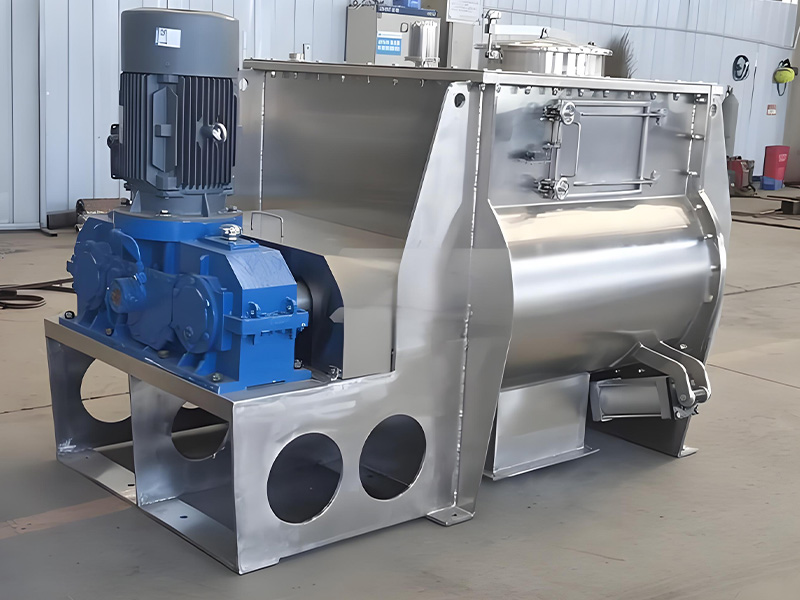
A double shaft paddle mixer contains two rotating shafts equipped with paddle assemblies. The coordinated movement of the paddles creates material lifting, throwing, convection and redistribution within the mixing chamber.
This mixing mechanism is suitable for evaluating applications involving powders, granules and fibers, particularly when the ingredients have different physical characteristics or when a relatively short mixing cycle is required.
We provide double shaft paddle mixing equipment for chemical, food, pharmaceutical and feed processing applications. The actual configuration should be determined according to the material characteristics and required production conditions.
4. V-Mixer: Repeated Splitting and Recombination
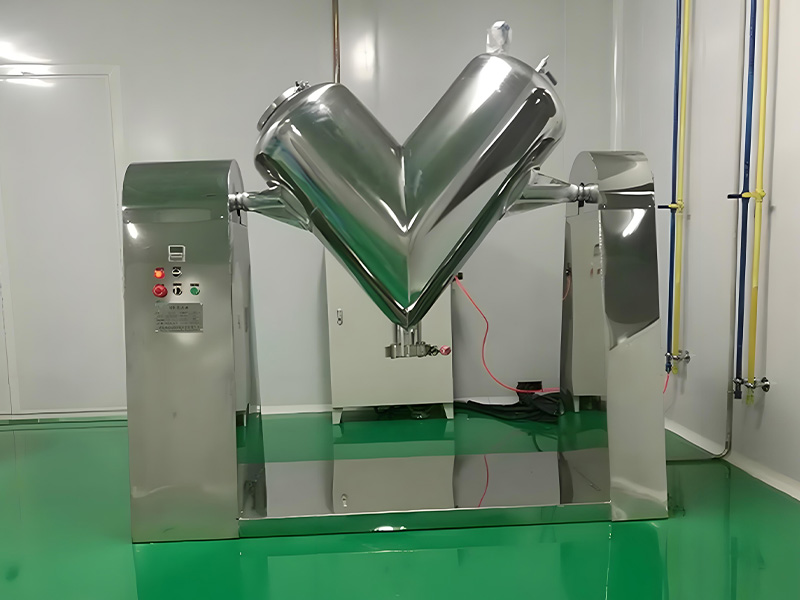
A V-mixer consists of two cylindrical sections connected to form a V-shaped rotating vessel. As the vessel rotates, the material repeatedly separates into different sections and recombines during subsequent movements.
This repeated splitting and recombination promotes particle redistribution through tumbling and diffusion. It is particularly relevant when selecting equipment for dry, free-flowing powders and granules that require relatively gentle handling.
The suitability of a V-type blender depends on powder flowability, particle characteristics, batch loading and the required blending uniformity. Cohesive or sticky materials generally require additional process evaluation.
Industrial Mixing Equipment Comparison: Which Mixer Fits Your Process?
Our industrial powder mixers use different mixing mechanisms to handle different materials and production requirements. Compare their operating principles and typical application considerations before selecting a suitable machine.
| Mixer Type | Mixing Mechanism | Typical Material Considerations | Production Considerations |
|---|---|---|---|
| Ribbon Mixer | Inner and outer ribbon circulation | Free-flowing powders, granules and selected wet mixing processes | Batch mixing, liquid addition and optional thermal processing |
| Ploughshare Mixer | Plough blade-driven lifting and dispersion | Cohesive powders, agglomerated materials and selected powder-liquid mixtures | Intensive mixing and optional dispersion components |
| Double Shaft Paddle Mixer | Coordinated dual-shaft paddle movement | Powders, granules, fibers and mixed physical properties | High-intensity batch mixing and material redistribution |
| Double Cone Mixer | Rotating double-cone tumbling | Dry powders and granules requiring gentle blending | Batch processing and particle-integrity considerations |
| Cone Mixer | Dual-spiral three-dimensional circulation | Powders and granules with different densities or particle sizes | Gentle mixing and optional process configurations |
| Square-Cone Mixer | Rotating square-cone material container | Dry powders and granules | Closed material handling and cleaning considerations |
| V-Mixer | Repeated splitting and recombination | Dry, free-flowing powders and granules | Gentle batch blending and vessel loading considerations |
| Continuous Mixer | Controlled continuous feeding, mixing and discharge | Materials with predictable flow and controlled feeding requirements | Steady production and automated process integration |
Important Selection Consideration
No single mixer is suitable for every powder processing application. A machine that works well with free-flowing granules may not deliver the same results with cohesive powders or moisture-sensitive formulations. Material testing, operating conditions, equipment configuration and discharge performance should all be considered before final equipment selection.
How to Select the Right Industrial Powder Mixing Equipment
Choosing the right industrial mixer requires more than comparing machine capacity or motor power. The material characteristics, mixing objectives, production workflow and cleaning requirements all influence equipment selection.
1. Evaluate Powder Flowability and Material Characteristics
Powder flowability determines how easily particles move, redistribute and circulate during mixing. Free-flowing powders generally work well with tumbling mixers and conventional ribbon mixing systems, while cohesive materials may require more intensive material movement.
Free-flowing powders: Evaluate ribbon, V-type and double-cone mixing mechanisms.
Cohesive or agglomerated powders: Consider ploughshare mixing and optional dispersion components.
Mixed powders and fibers: Evaluate double shaft paddle mixing according to the required material movement.
2. Consider Particle Size, Density and Fragility
When different ingredients have significantly different particle sizes or bulk densities, segregation may occur during loading, mixing or discharge. The mixing mechanism must provide sufficient redistribution without unnecessarily damaging fragile particles.
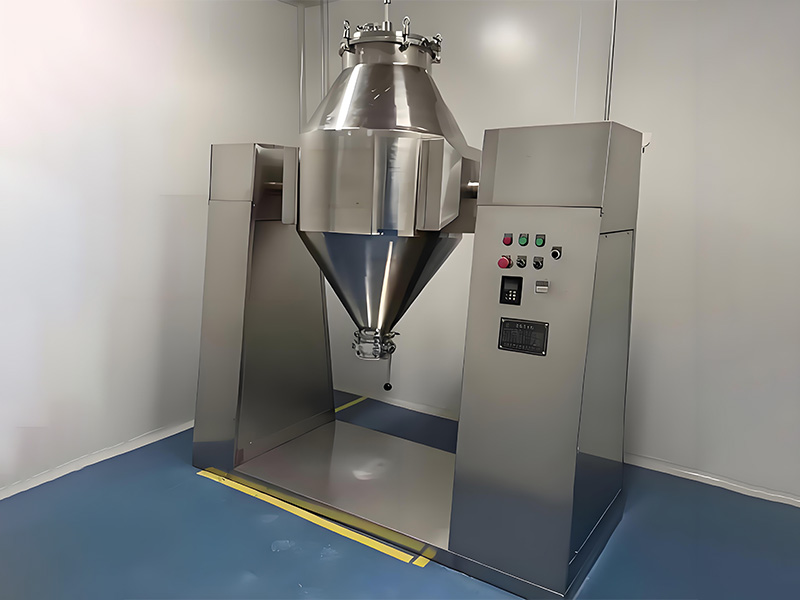
For fragile granules or materials sensitive to excessive mechanical action, evaluate tumbling-based mixing technologies. For ingredients with more challenging flow behavior, compare the movement pattern and intensity of paddle, ribbon and ploughshare systems through application testing.
3. Determine Whether Your Process Requires Liquid Addition
Some industrial formulations require a small proportion of liquid additives to be incorporated into dry powders. In these applications, the mixer must distribute the liquid throughout the material without creating excessive local wet spots or unwanted agglomerates.
We offer mixing equipment with application-dependent configurations. For powder-liquid processes, consider spray nozzle placement, liquid feeding control, agitator design, mixing intensity and the final moisture distribution. The appropriate machine should be confirmed through the actual formulation and process conditions.
4. Match the Mixer to Batch Size and Production Capacity
The nominal volume of a mixer does not automatically represent its effective working volume or finished batch output. Working capacity depends on the material's bulk density, required loading level, mixing behavior and discharge arrangement.
For batch production, evaluate the quantity processed per cycle, loading and unloading time, mixing time and the number of batches required per shift. For continuous production, evaluate the stable feed rate, mixing residence time and downstream handling capacity.
5. Evaluate Material Contact Surfaces and Cleaning Requirements
Material contact surfaces should be selected according to product hygiene, corrosion resistance, abrasion and cleaning requirements. Stainless steel is commonly considered in food and pharmaceutical processing, while carbon steel may be suitable for selected non-corrosive industrial applications.
304 Stainless Steel
A common option for general food-related and industrial material contact applications, subject to the chemical compatibility of the process.
316L Stainless Steel
Can be considered for applications requiring enhanced corrosion resistance, depending on the materials and operating environment.
We can consider different material and surface configurations according to equipment type and application requirements. Actual material selection should be confirmed against chemical compatibility, cleaning procedures and relevant industry requirements.
6. Check Discharge Design, Maintenance and Production Integration
A suitable industrial mixer must operate efficiently beyond the actual mixing stage. Discharge opening design, residue retention, access for cleaning, shaft seals and maintenance access can all affect production efficiency.
For automated processing facilities, the mixer should also be evaluated together with upstream feeding and dosing equipment and downstream screening, conveying and packaging systems.
We provide powder and granular material processing equipment covering feeding, conveying, mixing, screening, packaging and palletizing. Considering these processes together helps establish a more practical production line configuration.
A Practical Approach to Industrial Mixer Selection
Start with the material properties, define the desired mixing result, identify the required batch or continuous production method, and then evaluate the equipment structure and process configuration. This approach helps reduce the risk of selecting a mixer that performs well in isolation but does not fit the overall production process.
Batch Mixing vs. Continuous Mixing: Which Production Method Is Right for You?
Batch mixers and continuous mixers serve different industrial production workflows. The right choice depends on formulation stability, production volume, recipe changes, feeding accuracy and process control requirements.
Batch Mixing: Controlled Processing of Individual Batches
Batch mixing involves loading a predetermined quantity of ingredients into the mixer, processing the materials for a defined mixing cycle and discharging the finished mixture before beginning another batch.
Typical batch production sequence
Batch mixing is particularly useful when production involves multiple formulations, different ingredient ratios, frequent product changes or quality checks performed on individual batches. Ribbon mixers, ploughshare mixers, double shaft paddle mixers, cone mixers and V-type mixers are among the batch equipment options in our product range.
Continuous Mixing: Uninterrupted Material Processing
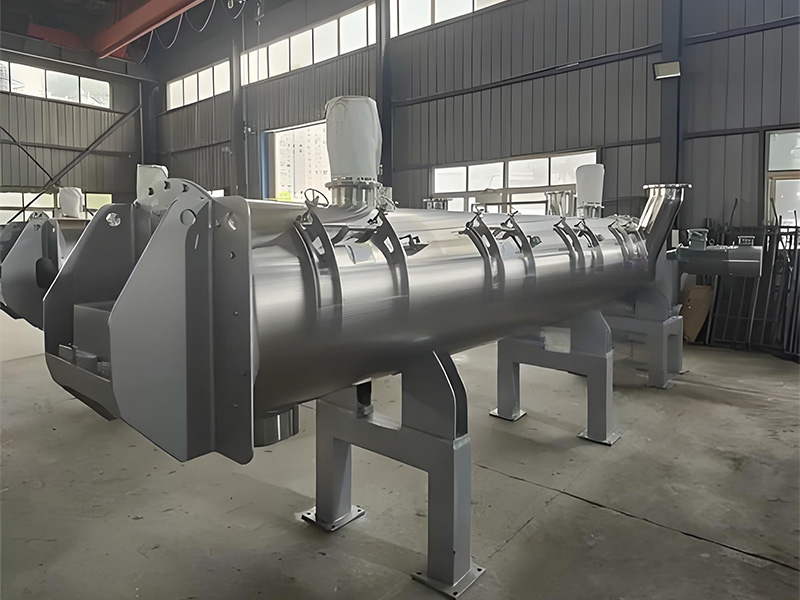
Continuous mixing operates through simultaneous feeding, mixing and discharge. Different ingredients enter the mixing chamber at controlled feed rates, and the internal mixing elements redistribute the materials before the finished blend exits continuously.
Typical continuous production sequence
This method is suitable for production lines that require a stable material flow and sustained output. Feeding accuracy, material flow consistency, residence time and discharge control are important factors in maintaining blend quality.
Key Differences Between Batch and Continuous Mixing
| Evaluation Factor | Batch Mixing | Continuous Mixing |
|---|---|---|
| Production Flow | Separate production cycles | Uninterrupted material flow |
| Recipe Changes | More flexible for frequent changes | Best suited to relatively stable formulations |
| Production Control | Individual batch monitoring | Continuous feeding and process monitoring |
| Feeding Requirements | Ingredients loaded for each batch | Stable and controlled material feeding |
| Production Planning | Suitable for varied production schedules | Suitable for sustained production runs |
| Quality Management | Batch-based sampling and traceability | Continuous monitoring and representative sampling |
Our approach: We consider the entire production workflow when evaluating mixing equipment. For continuous production projects, the mixer should work in coordination with feeding, conveying, storage and packaging equipment. For flexible production, batch mixing provides a practical approach to managing different formulations and production cycles.
Frequently Asked Questions About Industrial Mixing Equipment
Explore practical answers to common questions about industrial powder mixers, equipment selection, material compatibility, production requirements and supplier evaluation.
1. How should you choose between a ribbon mixer and a ploughshare mixer for different powder materials?
The choice mainly depends on powder flowability, cohesiveness, moisture content and the required mixing intensity. A ribbon mixer is commonly considered for free-flowing powders and granules that require continuous axial and radial circulation. Its inner and outer ribbons create counter-current material movement within a horizontal trough.
A ploughshare mixer uses plough-shaped blades to lift and redistribute material more intensively. It can be more suitable for evaluating cohesive powders, agglomerated materials and selected powder-liquid mixing applications. When making the final decision, compare mixing time, product characteristics, cleaning requirements and the actual formulation rather than relying on equipment names alone.
2. Which industrial mixer is suitable when raw materials have significantly different particle sizes or bulk densities?
When materials have different particle sizes or bulk densities, segregation can occur during material movement, mixing and discharge. Double shaft paddle mixers and conical mixing systems are worth evaluating because their mixing mechanisms create different patterns of material redistribution.
The best configuration depends on the degree of density difference, particle flowability, ingredient proportions and the required blending uniformity. We recommend evaluating the actual raw materials and conducting representative mixing tests before confirming a machine configuration. Sampling at different positions or discharge stages can help assess whether the selected equipment delivers consistent results.
3. Which powder mixing equipment is more suitable for fragile granules that must retain their original particle structure?
For fragile granules, the mixing mechanism should minimize unnecessary impact, compression and excessive mechanical shear. V-type mixers and double cone mixers are commonly considered because they use rotating vessel movement to redistribute dry materials through tumbling and particle recombination.
However, gentle mixing does not automatically guarantee that particles will remain intact. Vessel speed, filling level, batch size, mixing duration and discharge conditions can all affect particle breakage. Before purchasing an industrial blender for fragile materials, evaluate the percentage of broken particles and the final blend quality under representative operating conditions.
4. Can an industrial powder mixer incorporate liquid additives into dry powder without creating local agglomerates?
Yes, selected industrial mixing configurations can incorporate liquid additives into dry powders. However, achieving uniform liquid distribution requires appropriate equipment and process design. Important considerations include spray nozzle arrangement, liquid feed rate, powder flowability, moisture sensitivity and mixing intensity.
A horizontal ribbon mixer or ploughshare mixer with an appropriate liquid spray system may be evaluated for this type of application. For cohesive or difficult-to-disperse formulations, optional high-speed choppers may also be considered. We recommend confirming the liquid addition method and mixing configuration through application testing before finalizing the equipment.
5. Which mixing machine is more practical for a factory producing several powder formulations with frequent product changes?
Batch mixing is generally more practical when a factory frequently changes formulations, ingredient ratios or production schedules. Each batch can be loaded, mixed, inspected and discharged separately, providing clearer production boundaries.
Equipment selection should also consider cleaning frequency, residue retention, product cross-contamination risks and the time required to prepare the next batch. For applications requiring convenient material transfer or closed handling, a square-cone mixer with a mobile material container may be worth evaluating. The final choice should be based on the actual cleaning and production workflow.
6. When should a manufacturer choose a continuous powder mixer instead of a batch mixing machine?
A continuous powder mixer is generally suitable when a factory processes relatively stable formulations and requires uninterrupted material feeding, mixing and discharge. It can reduce repeated loading and unloading operations and integrate more naturally into automated production lines.
A batch mixer is often preferable when formulations change frequently, individual batch inspection is important or production requires flexible scheduling. Before selecting continuous mixing equipment, evaluate ingredient dosing accuracy, feeding stability, residence time, process monitoring and downstream capacity. Continuous mixing performance depends on the entire feeding and mixing system, not only the mixer itself.
7. What stainless steel grade should you specify when purchasing a mixer for food or pharmaceutical powder processing?
The selection of stainless steel depends on the material being processed, cleaning chemicals, corrosion exposure, hygiene requirements and applicable industry standards. Grade 304 stainless steel is commonly considered for general-purpose processing, while 316L stainless steel may be appropriate where enhanced corrosion resistance is required.
We offer mixer configurations using stainless steel options such as 304 and 316L, depending on the equipment and application. Buyers should also verify the material used for all product-contact components, the internal surface finish, weld quality, discharge structure and cleaning accessibility. A stainless steel construction alone does not automatically establish compliance with a particular food or pharmaceutical standard.
8. What should industrial buyers check when purchasing a powder mixer for dusty or potentially combustible materials?
Dust generation and combustible dust risks should be evaluated before selecting equipment. Buyers should identify the material's dust characteristics, potential ignition sources, operating environment and applicable local safety regulations.
Important engineering considerations may include sealed feeding and discharge connections, dust extraction, grounding and bonding, suitable electrical components, temperature monitoring and appropriate explosion protection measures where required. The actual safety configuration must be determined through a documented risk assessment. We recommend confirming the required safety specifications and equipment configuration before production and installation rather than assuming that a standard mixer is suitable for every combustible material.
9. How can a purchasing team verify mixing uniformity before approving an industrial mixer for bulk production?
Mixing uniformity should be evaluated using representative raw materials and an agreed testing method. A practical evaluation can include collecting samples from different locations or discharge stages and measuring the concentration of a suitable indicator component.
The test should also consider batch loading, mixing duration, ingredient proportions, material segregation and discharge behavior. For continuous mixing, sampling should cover representative periods of steady operation. Buyers should agree on the sampling method, acceptance criteria and test conditions before equipment acceptance. A quoted mixing uniformity percentage is meaningful only when its testing method and material conditions are clearly defined.
10. What equipment should be considered when integrating an industrial powder mixer into a complete production line?
A complete powder processing line may include raw material unloading, feeding, weighing, conveying, mixing, screening, storage, packaging and palletizing equipment. The required configuration depends on the production process, material handling characteristics, automation objectives and available factory space.
For example, a mixing system may use vacuum feeders or screw conveyors for material transfer, a suitable mixer for blending, screening equipment for particle separation and automatic packaging machinery for finished product handling. We provide powder and granular material processing equipment covering these production stages and can evaluate equipment combinations according to the actual process arrangement. Considering upstream and downstream equipment together helps improve production coordination and reduces integration problems during installation and commissioning.